
How the digital publishing landscape has fundamentally shifted, and what European publishers must do to reclaim control
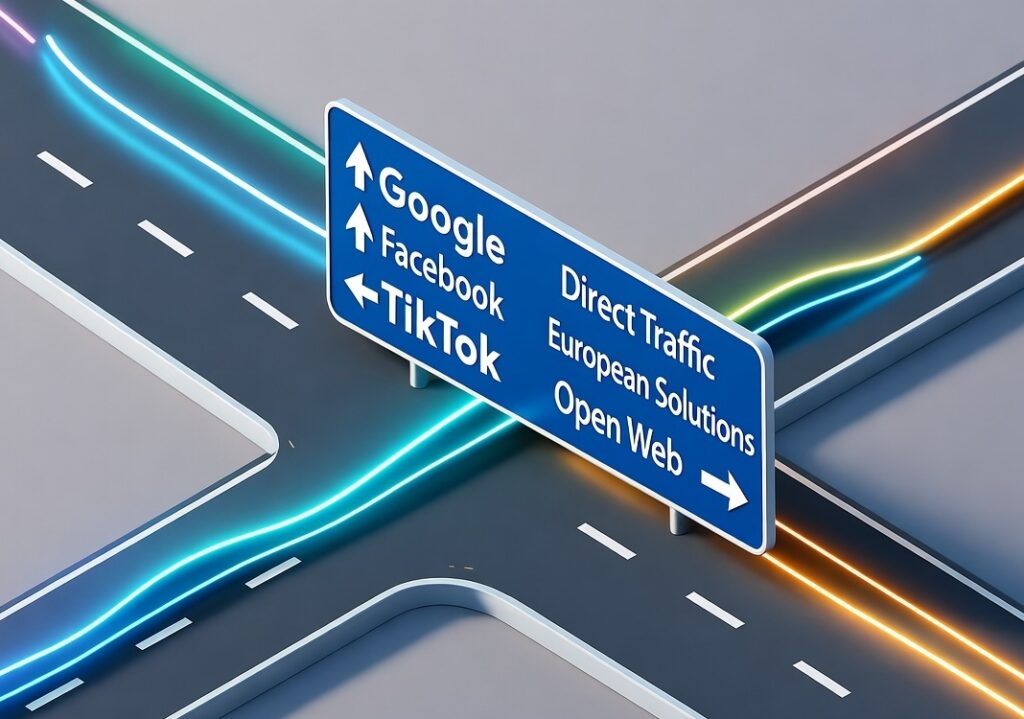
As 2025 draws to a close and we head into 2026, it’s time for publishers to face an uncomfortable truth: the game has changed, and most of us didn’t even realize we were losing. The past few years have brought a cascade of changes that have fundamentally altered how content reaches audiences, how revenue flows, and who really controls the relationship between publishers and readers.
Let’s take an honest look at where we stand and, more importantly, what we can do about it.
1. Traffic Sources Are More Challenging Than Ever
Remember when traffic sources were relatively predictable? You had SEO, maybe some social media magic, and if you were smart, you built an email list. As long as you survived the occasional Google Core Update and could ride the wave of whatever new platform was hot, your business could thrive.
Back then, SEO was largely about understanding Google’s preferences and optimizing your content accordingly. The open web was genuinely thriving—content creators had multiple paths to reach audiences, and links between sites created a vibrant, interconnected ecosystem. Publishers could build sustainable businesses based on creating valuable content and optimizing it for discovery.
But starting in the mid-2010s, something fundamental began to shift.
The Platform Takeover Begins
Platforms started capturing more and more of the traffic that used to flow directly to publishers. Twitter, Facebook, and even Google’s ill-fated Google Plus became the new promised lands where publishers rushed to build “direct relationships” with their audiences.
What we didn’t fully grasp at the time was that we were essentially handing over our most valuable asset—the direct connection to our readers—to intermediaries whose business models were fundamentally at odds with ours. The platforms promised reach and engagement, but what they delivered was dependency.
As these platforms matured, outbound traffic began to decline. Why send users away when you could keep them scrolling within your own ecosystem? The “direct relationship” we thought we were building was actually just another layer of mediation, one where we had even less control than before.
More recently, platforms like TikTok and LinkedIn have joined this traffic capture game, each with their own algorithmic peculiarities that further fragment publisher audiences and create new dependencies.
2. The 2020 Vision: Google Discover and the Death of Evergreen Content
Since early 2020, Google Discover has revolutionized—or arguably destroyed—traditional content strategies. The rise of Google’s recommendation algorithm has fundamentally changed what works in digital publishing.
Evergreen content is dead. Those carefully researched, comprehensive articles that could drive traffic for months or years? They’re largely irrelevant now. Only immediate, trending, reactive content can cut through the noise and reach significant audiences through Discover.
The numbers tell the story: Google Discover became the primary traffic source for French press in 2024, generating over 500 million clicks per month—representing 68% of all Google traffic to publishers. When a single algorithm controls such a massive portion of your potential audience, you’re not running a publishing business; you’re running a content farm optimized for Google’s preferences.
This shift has pushed publishers into a perpetual hamster wheel of reactive content creation. We’re optimizing for algorithmic engagement rather than reader value, for speed rather than accuracy, for emotional triggers rather than thoughtful analysis.
3. The Awakening: Platform Dependency Has Become a Trap
Here’s the uncomfortable truth many publishers are finally acknowledging: our dependence on platforms has become unsustainable.
We’ve spent years building our strategies around platforms that can change their algorithms overnight, adjust their revenue sharing models without notice, or simply decide that publishers are no longer a priority. We’ve become digital sharecroppers, working land we don’t own and can’t control.
The platforms that once promised to democratize content distribution have become gatekeepers who determine which publishers live and which die. TikTok’s algorithm shows systematic bias in political content distribution, with recent studies revealing it promoted Republican content by approximately 11.8% more than Democratic content during the 2024 US elections. Meanwhile, LinkedIn has descended into what critics call “cringe territory”, with a 670,000-member Reddit community called “LinkedIn Lunatics” dedicated to mocking the platform’s increasingly caricatural content.
This awakening is painful but necessary. Publishers who recognize their vulnerability and start building alternatives now will be the ones who survive what’s coming next.
4. Prebid’s Promise Meets Google’s Resistance
Prebid emerged as a beacon of hope—an open-source solution that promised to level the playing field by allowing multiple demand sources to compete fairly for publisher inventory.
But Google had other plans.
Recent revelations from the DOJ antitrust trial revealed that Google deliberately blocked Prebid’s integration with the IAB Tech Lab in 2017, forcing the initiative to operate independently rather than becoming an industry standard. This wasn’t market competition; it was strategic interference designed to fragment the opposition to Google’s dominance.
Even today, Google continues to undermine Prebid through various competitive advantages that border on anti-competitive practices. Faster ad serving, preferential access to inventory, and integration benefits that make it nearly impossible for other demand sources to compete on equal terms.
The message is clear: Google will tolerate alternatives to its dominance only as long as they remain ineffective.
5. Privacy Sandbox: A Regulatory Victory for the Open Web
Remember Privacy Sandbox? Google’s supposed commitment to privacy-preserving advertising that was going to revolutionize the industry and phase out third-party cookies?
It’s dead. Officially abandoned in October 2025 after years of delays and industry resistance.
What Privacy Sandbox really represented was Google’s attempt to replace an imperfect but relatively open system (third-party cookies) with a closed system where Google controlled all the infrastructure. Under the guise of privacy protection, Google was positioning itself to have even more control over digital advertising.
The abandonment of Privacy Sandbox should be celebrated as a victory for publishers and the open web. Thanks to regulatory pressure from authorities like the UK’s Competition and Markets Authority and industry pushback, Google was forced to abandon technologies that would have further entrenched its dominance while making life more difficult for competitors.
However, this victory comes with a caveat: the need for genuinely privacy-respecting alternatives to third-party cookies remains. The challenge now is developing solutions that protect user privacy without centralizing control in the hands of a single platform giant.
6. Google’s Advertising Stranglehold: Total Supply Chain Domination
Let’s talk about the elephant in the room: Google’s control over digital advertising isn’t just significant—it’s totalitarian.
Google controls:
- Traffic sources through Search and Discover
- The sell-side through Google Ad Manager
- The demand-side through DV360
- The exchange where auctions happen
- The analytics that measure everything
- The tools that optimize campaigns
This isn’t competition; it’s vertical integration designed to capture value at every step of the advertising supply chain. Google has positioned itself as player, referee, scorekeeper, and stadium owner all at once.
The scale of this dominance is finally being challenged in courts on both sides of the Atlantic. In the United States, Google has faced two landmark antitrust defeats in 2024 and 2025. The first case, decided in August 2024, found that Google illegally monopolized the search market. While the Department of Justice had initially sought to force Google to sell Chrome, Judge Amit Mehta ultimately rejected this demand in September 2025, instead requiring Google to end exclusive search deals and share search data with competitors.
More significant for publishers is the second case: in April 2025, Judge Leonie Brinkema ruled that Google illegally monopolized both the ad exchange market and the ad server market. Internal emails revealed during the trial showed Google’s strategy explicitly, with one Google ads staffer writing in 2013: “our goal should be all or nothing—use AdX as your SSP or don’t get access to our demand”.
The remedies phase for the advertising case began in September 2025, with the DOJ seeking to force Google to divest its ad exchange (AdX) and publisher ad server (DFP) businesses. The government’s proposal involves a three-phase structural remedy: first forcing Google to give competitors real-time access to AdX data, then open-sourcing its auction logic, and finally full divestiture of both DFP and AdX under court supervision. A final ruling is expected in 2026, not 2025, according to industry experts.
The financial stakes are enormous: Google’s ad tech business generated $30 billion in revenues in 2024, double from a decade ago, while the company pays Apple billions of dollars per year to remain the default search engine on iPhones. For European publishers, this American legal battle represents a potential watershed moment—the first real challenge to a system where Google extracts value at every layer of the advertising supply chain.
For publishers, this means that even when you “win,” Google wins more. The company that controls your traffic also controls how your advertising revenue is calculated, allocated, and distributed. The lack of transparency isn’t accidental—it’s strategic.
7. Civil War in Programmatic: The Trade Desk’s Power Play
The programmatic advertising ecosystem is experiencing its own crisis, with The Trade Desk’s announcement of OpenAds creating significant friction within the Prebid community.
The trigger for this conflict was Prebid’s controversial decision in August 2025 to change how Transaction IDs (TIDs) work. Previously, TIDs were universal identifiers shared across all participants in an auction, allowing demand-side platforms like The Trade Desk to track conversions and avoid duplicate bidding. Prebid quietly updated its system to assign unique TIDs to each bidder instead of sharing the same ID across all participants.
This change was implemented with minimal advance warning to the industry, causing immediate pushback from The Trade Desk and other buy-side platforms. DSPs rely on consistent TIDs to identify and avoid bidding multiple times on duplicated impressions—a critical tool for campaign optimization and fraud prevention.
The Trade Desk’s response was swift and dramatic. Rather than accept Prebid’s new TID policy, TTD announced OpenAds—essentially a forked version of Prebid that maintains universal TID sharing. Industry analysts note that this represents “The Trade Desk stepping into the auction itself” rather than just participating as a buyer.
The tension escalated when The Trade Desk CEO Jeff Green publicly criticized Prebid’s move as “a ploy to obfuscate the supply chain, allowing sellers and publishers who focus on supply chain shenanigans to monetize better than those who focus on driving demand for quality content.”
Recognizing the industry disruption, Prebid announced a compromise in late October 2025—just weeks after The Trade Desk’s OpenAds announcement. The updated policy allows publishers to continue sending TIDs to specific SSPs if they choose, attempting to balance publisher control with buy-side transparency demands.
However, the damage to industry unity was already done. The Trade Desk—historically a buy-side company—has effectively moved into controlling auction mechanics, raising serious questions about conflicts of interest when a major demand source also controls the infrastructure that determines auction outcomes.
This civil war illustrates the fragility of “open” initiatives when powerful players can simply fork the code and create their own rules. Publishers now face the prospect of managing multiple auction standards and potentially being forced to choose between competing programmatic frameworks—exactly the kind of fragmentation that benefits neither publishers nor genuine market competition.
8. Publishers Fight Back: The Return to Direct Relationships
Amidst all this chaos, there’s one bright spot: publishers are rediscovering the value of direct relationships with their audiences.
The tools that were often ignored or deprioritized during the platform gold rush are experiencing a renaissance:
Email Newsletters: The Strategic Renaissance
Email newsletters are providing stable, predictable audience engagement and have evolved far beyond simple content distribution. Publishers are developing sophisticated newsletter strategies that include:
Dedicated Content Creation: Publishers like Morning Brew and The Hustle have built entire business models around newsletter-first content, creating material specifically designed for email consumption rather than repurposing website articles.
Vertical Segmentation: Smart publishers are developing multiple newsletters targeting different audience segments—technology newsletters for IT professionals, market analysis for investors, lifestyle content for consumers—allowing for more precise targeting and higher engagement rates.
Tonal Adaptation: The newsletter format allows for more personal, conversational communication with readers. Publishers can adopt a more direct, authentic voice that cuts through the corporate-speak often required on platforms, building genuine connections with subscribers.
Direct Reader Communication: Newsletters enable two-way conversations through reply-to features, surveys, and feedback mechanisms, creating community around content rather than just consumption.
Messaging Apps: Platform Control Tightens
Push notifications are enabling real-time reader connections, while messaging apps are facilitating direct publisher-reader communication—though this channel faces increasing platform control challenges.
Publishers have been experimenting with platforms like WhatsApp, Telegram, Signal, and Discord to reach audiences directly. However, WhatsApp—owned by Meta—demonstrates the platform dependency problem even in supposedly “direct” channels. Meta recently announced that starting January 15, 2026, WhatsApp will ban all third-party AI chatbots, including ChatGPT and Perplexity, while keeping its own Meta AI integrated.
This ban will affect over 50 million users who currently use ChatGPT through WhatsApp, forcing them to migrate to OpenAI’s standalone apps. Meanwhile, Meta AI remains deeply integrated across WhatsApp, Instagram, and Facebook, demonstrating how platform owners can arbitrarily cut off competitors while promoting their own services. The irony is stark: publishers seeking to escape platform dependency by using messaging apps find themselves subject to the same arbitrary rule changes.
Podcasts: Engagement vs. ROI Challenges
Podcasts are creating intimate, loyal audiences, but achieving positive return on investment remains challenging for many publishers. While podcasts can generate deep audience engagement and loyalty, the production costs—including equipment, editing, hosting, and promotion—often outweigh revenue for smaller publishers. The time investment required to build a sustainable podcast audience can be substantial, making it difficult for resource-constrained publishers to justify the investment despite the format’s potential for building direct relationships.
The Measurement Challenge
The data backs this diversification strategy: according to industry reports, 56% of publishers are now focusing more on driving direct traffic. Why? Because owned media channels provide stability and predictability that platform-dependent strategies simply cannot match.
However, rebuilding these direct relationships requires significant investment and patience. Publishers must compete not only with platforms for attention but also with the convenience and personalization that algorithmic feeds provide. The challenge lies in creating value propositions compelling enough to convince readers to actively engage rather than passively consume algorithmic recommendations.
9. France Under Siege: The AI Content Invasion
France faces a particularly acute version of a global problem: AI-generated content is overwhelming legitimate journalism on Google Discover.
The numbers are staggering: 18% of the most recommended media sites and 33% of tech sites on Google News in France are generated by AI. Recent investigations revealed that a single operator, working part-time, managed to generate over 7,700 articles in 15 days—averaging 510 articles per day—and achieved higher Google Discover recommendation rates than established French media outlets like Ouest France, Le Parisien, and BFM TV.
This isn’t just about fake news—it’s about industrial-scale content generation that captures traffic and advertising revenue while spreading misinformation. When Google’s algorithms consistently promote AI-generated sites over legitimate journalism, we’re witnessing a fundamental threat to the information ecosystem.
The fact that this is happening most acutely in France—a market that’s not Google’s primary focus—suggests this is just a preview of what’s coming to other regions.
10. Commercial and Regulatory Tensions: The Need for European Digital Sovereignty
The challenges facing European publishers highlight critical commercial and regulatory tensions between European authorities and global platform companies. These aren’t just technological disagreements—they’re fundamental conflicts over market structure, data governance, and democratic values.
European regulators are increasingly at odds with platform companies over compliance with the Digital Services Act, data protection requirements, and competition law. Recent investigations into TikTok’s algorithm bias in European elections demonstrate how platform policies developed for one market can distort democratic processes in another.
The regulatory environment continues to evolve, with European authorities pursuing antitrust actions and content moderation requirements that often conflict with platform companies’ global operational strategies. This creates an unstable environment where publishers are caught between rapidly changing regulatory requirements and platform policies designed primarily for American markets.
Building European solutions for analytics, advertising technology, and content distribution isn’t just about technological sovereignty—it’s about ensuring that European publishers can operate under frameworks designed with European interests in mind.
11. The LLM Apocalypse: ChatGPT and the End of Click-Through
If everything we’ve discussed so far feels challenging, brace yourself for what might be the final blow to traditional publisher traffic models: large language models.
Systems like ChatGPT, Google’s AI Overviews, and similar tools consume and summarize content but provide minimal traffic back to original sources. It’s a one-way value extraction system where publishers provide the raw material, and AI companies capture the value.
The early data on AI Overviews is devastating:
- Click-through rates decline by 34-89% when AI Overviews appear
- Zero-click searches increased from 56% to 69% between May 2024 and May 2025
- Some publishers report traffic drops severe enough to force business closures
Educational sites like Chegg have seen 49% declines in traffic. Specialized publications report 90% drops. This isn’t evolution—it’s an extinction-level event for content-dependent businesses.
The cruel irony? Publishers’ content is being used to train the AI systems that are directly competing with them for audience attention, while receiving little to no compensation or traffic in return.
12. 2026: A Call to Action for European Publishers
So where does this leave us as we head into 2026?
We have a choice. We can continue down the path of platform dependency and hope that Google, Facebook, and the others will suddenly develop a conscience and start prioritizing publisher interests. Or we can start building resilient, diversified strategies that reduce our vulnerability to algorithmic changes and platform policies.
Here’s what successful European publishers will be doing in 2026:
Diversifying Traffic Sources
Stop putting all your eggs in the Google basket. Build email lists, develop podcast audiences (while carefully managing costs), create compelling reasons for readers to visit your site directly.
Investing in European Tools
Support and use analytics and advertising tools developed with European publishers’ interests in mind. Tools like Alke Analytics offer group analytics, real-time data, and publisher-specific metrics that Google Analytics simply doesn’t provide—because Google’s interests aren’t aligned with yours. As a European solution, Alke understands the regulatory environment and business challenges specific to European publishers.
Building Direct Revenue Streams
Subscriptions, memberships, events, consulting—create revenue sources that don’t depend on programmatic advertising controlled by platform intermediaries.
Demanding Transparency
Stop accepting opaque systems where you can’t understand how decisions affecting your business are made. Demand real transparency from advertising partners and analytics providers.
Collaborating with Other Publishers
The platform economy succeeds by fragmenting publishers and making us compete against each other. Building coalitions and shared infrastructure is how we fight back.
Supporting European Digital Infrastructure
Advocate for and invest in European alternatives to American-dominated platforms. Help founders to build global champions.
The Choice Is Ours
The open web stands at a crossroads. The direction we take in 2026 will determine whether we preserve a diverse, independent publishing ecosystem or whether we surrender completely to platform control.
This isn’t about nostalgia for the “good old days” of the web. It’s about recognizing that the current trajectory leads to a future where a handful of platform companies control all information distribution, where AI systems replace human journalism, and where publishers become irrelevant intermediaries in their own industry.
But it doesn’t have to be this way. Publishers who recognize the challenges, invest in alternatives, and start building resilient business models now will be the ones who shape the web’s future.
The platforms had their moment. Privacy Sandbox’s failure shows that regulatory pressure and industry resistance can work. The growing criticism of LinkedIn’s content degradation and TikTok’s algorithmic bias demonstrates that platform overreach creates opportunities for alternatives.
Now it’s time for publishers to reclaim their independence.
The open web’s future isn’t something that happens to us—it’s something we build together.
