
Google is not slowing down. It is speeding up.
Google has spent 2026 pushing AI Overviews and AI Mode into every corner of its search engine. They reached France on 22 July, two years after the US. On 3 November, Google told American schools that rejecting AI would also mean losing Google Search.
At the same time, the bill is getting heavier. Publishers are losing traffic, regulators are investigating, a German court has made Google liable for what its AI writes, and investors have just wiped close to $500 billion off Alphabet in a single day.
So why rush? Our reading is simple. Google is racing to make AI Overviews inseparable from Search before a regulator or a judge forces it to switch them off. And for publishers, that changes how they should measure what Google still sends them.
Twelve months that tell the story
Taken one by one, these events look like separate news items. Put side by side, they show a company accelerating while the pressure builds.
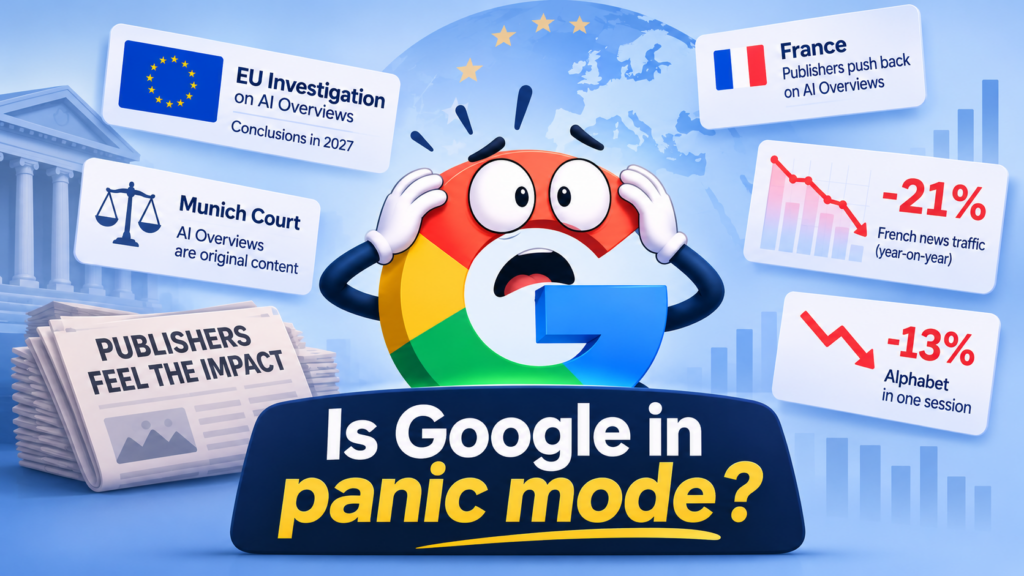
- December 2025. The European Commission opens an antitrust investigation into Google’s use of publisher content and YouTube videos to feed its AI features. Conclusions are not expected before 2027.
- 28 May 2026. A regional court in Munich orders Google to stop AI Overviews from spreading false fraud allegations about two publishers. The court treats AI Overviews as Google’s own content, not as search results.
- 22 July 2026. AI Overviews and AI Mode launch in France, without consultation according to publishers. France was the last country still without them.
- August to October 2026. French news publishers (APIG) and press agencies (FFAP) take Google to the Autorité de la concurrence. On 30 October, five trade bodies (SEPM, Geste, SPIIL, CPA, FNPS) file their own complaint in Brussels.
- September 2026. Traffic to French news media drops 21% year on year, according to ACPM certified figures. Le Parisien is down 39%, Franceinfo 29%, Le Figaro 22%, Le Monde 20%.
- Early October 2026. In the US, Judge Amit Mehta dismisses Penske Media’s antitrust claim over AI Overviews. The plaintiffs had failed to show, among other things, that AI Overviews and Search are separate products.
- Late October 2026. Alphabet loses more than 13% in one session, close to $500 billion, and Reddit loses about a quarter of its value. Revenue is up at both companies: investors are pricing the AI shift, not the quarter.
- 3 November 2026. Google tells US schools that blocking AI entirely will also block Google Search. In Google’s own words: “Search and A.I. are deeply integrated”.
What the numbers say
Two details from the financial results deserve a closer look. Alphabet’s revenue grew 25% to $127.6 billion, but net profit fell by about a quarter and search advertising grew at its slowest pace in five quarters. Google’s chief business officer also acknowledged that AI queries are harder to monetize than classic searches. That comes with more than $200 billion of planned capital expenditure this year.
Reddit tells the same story from the other side. Its revenue rose 53%, yet the stock fell sharply after the company said it was losing more than a million visitors a week since AI summaries arrived. Its CEO, Steve Huffman, put it bluntly: Google used to be a source of traffic, and it no longer is. In his view, AI Mode sends no traffic, to Reddit or to anyone else he knows of.
The legal crux: is AI Overviews a separate product?
Behind the complaints, one question decides almost everything. Are AI Overviews part of Search, or a product of their own?
In the US, Judge Mehta answered in Google’s favour, at least for now. Penske Media, the publisher of Rolling Stone, Billboard and Variety, argued that Google traffic had collapsed since AI Overviews launched, with affiliate revenue down more than 30%. The judge dismissed the claim. He found no contract promising publishers traffic in exchange for their content: they expected traffic, but an expectation is not an agreement. And he found no proof that AI Overviews and Search are two distinct products. His reasoning is worth reading closely. If users are happy with the AI answer and no longer scroll to the links, he wrote in substance, that suggests a single demand for information, not two separate demands.
The Munich court drew the opposite line. It distinguished AI Overviews, which generate new text loosely based on sources, from classic results, which list sources and quote them. For the court, an AI Overview is Google’s own content. Google is no longer a neutral intermediary pointing to other sites. It is directly responsible for what it publishes. The ruling (case 26 O 869/26) is a preliminary injunction and Google has announced an appeal, but the reasoning is now on record.
If the Munich view spreads, three consequences follow:
- Liability. Google answers for what its AI writes, errors included, like any publisher.
- Separation. A regulator can order Google to switch off AI Overviews, or to offer them on different terms, without touching the search engine itself.
- Tying. Bundling a separate product with a dominant search engine becomes a credible antitrust argument.
Why the fait accompli makes sense for Google
Read Judge Mehta’s reasoning again. The more users treat the AI answer as the answer, the harder it becomes to argue that AI Overviews are a separate product. Adoption is not only a business goal for Google. It is a legal defence.
That explains the speed. Every market where AI Overviews become the default, every user who stops scrolling, every school that keeps AI to keep Search, strengthens the claim that search and AI are one and the same thing. The schools decision says it out loud: Google could have let schools disable AI and keep classic search. It chose to tie the two together, and to justify it by saying they are deeply integrated.
The calendar works in Google’s favour. The European investigation will not conclude before 2027. The French cases before the Autorité de la concurrence will take months. By then, AI Overviews will have been part of French search habits for well over a year.
Two caveats keep this honest. Shareholder pressure is more likely to push Google to monetize AI Overviews faster, with more ads inside them, than to withdraw them. And Google has already made concessions: in France, publishers can opt out of AI Overviews without losing their ranking in classic search, and the UK competition authority has imposed the same option, which Google plans to extend. But opting out means disappearing from the place where readers now get their answer. For most publishers, that is not a real choice.
What publishers should measure after AI Overviews
Waiting for regulators is not a strategy. The traffic lost in the meantime will not come back. What publishers can control is how precisely they see the damage, and where they act.
Google Search and Discover have long brought around 70% of French news traffic. A site-wide figure hides how unevenly AI Overviews hit that traffic. Evergreen guides, recipes and explainers answer exactly the questions an AI summary can handle. Breaking news, opinion and local reporting are harder to summarize. The same publisher can lose half its search traffic on one section and almost nothing on another.
Compare the months before and after the AI Overviews launch in your market, 22 July for France, and look at five things:
- Search sessions by section: where AI Overviews are absorbing clicks, and where they are not.
- Revenue from search traffic, by section: which lost sessions actually cost money, and which were low-value anyway.
- Share of direct and returning readers: whether your own audience is growing fast enough to replace what Google takes.
- Active time per source: whether the readers who still come from Search are worth more or less than before.
- Goal conversion rate by source: which channels bring the readers who subscribe or register, now that search brings fewer of them.
The last two matter most. A publisher losing 20% of its search sessions but keeping its most engaged readers is in a very different place from one losing the readers who converted. Only page-level data on both audience and revenue tells them apart.
How Alke Analytics measures the AI Overviews impact
Alke Analytics puts audience and revenue in the same dashboard. Ad revenue is reconciled the next day and attributed down to the individual pageview, so every report can answer in euros, not just in sessions.
See the loss where it lives. Open the Monetization report, filter on search traffic, then break it down by section or content type. Add an annotation on the AI Overviews launch date in your market, and every chart shows the before and after.
Find what still earns. Filtered on search traffic, Revenue Insights shows which topics, formats and contexts still lift RPM, everything else held equal. The Opportunities tab turns those drivers into projected revenue.
Build the audience Google cannot intercept. Goal Analysis shows which sections and channels bring the readers who subscribe or register. Those are the readers worth investing in when search traffic becomes less reliable.
Ask in plain language. With the Alke connector for AI assistants, a question such as “How much revenue did search traffic bring per section since 22 July, compared with last year?” returns real figures from your dashboard.
Panic or strategy, the result is the same
Is Google in panic mode? Its stock price says investors are nervous. Its behaviour says something else: a company that knows the legal window is open, and is using every month of it to make AI Overviews impossible to separate from Search.
Regulators and judges may yet draw the line Munich drew. But publishers cannot plan around a verdict not expected before 2027. Those who see, section by section, what search traffic still brings and what it no longer brings will decide where to invest and where to stop. The others will watch their traffic slide and wait.
Want to see how AI Overviews affect your own revenue? Start a free 7-day trial or request a demo, and we’ll walk you through your search numbers.
Sources: Les Echos, Alphabet’s record stock drop · Les Echos, Reddit and the end of Google traffic · mind Media, 30 October 2026 · mind Media, 8 October 2026 · mind Media, 6 October 2026 · The New York Times, 3 November 2026 · PPC Land, Munich court ruling
